By Gamze Puchala
I step toward the edge of the little pond, careful of the mud. It has been pouring, but the rain has finally stopped. I look down, and my eyes meet the reflection of a roof on the water’s surface. “This is Anne Hathaway’s cottage, where she grew up,” the guide says.
I raise my head. The structure is achingly pretty, surrounded by beautiful greenery. Standing here, it is impossible not to see Agnes, the name Maggie O’Farrell reclaimed for Shakespeare’s wife in her novel Hamnet, walking these paths. In the book, and now in Chloé Zhao’s film adaptation, Agnes is a creature of the outdoors: a wild and peculiar woman who possesses innate skills, who is deeply connected to nature.
Stratford-upon-Avon has been a shrine to William Shakespeare, drawing tourists every year. As the film adaptation of Hamnet hits cinemas, a new wave of travelers is arriving. The book and the film invite us to view this heritage town through a different lens: through the eyes of the Bard’s wife, focusing on the love and loss of
the son whose name would echo in his father’s greatest tragedy. To find them, you have to look past the souvenir shops.
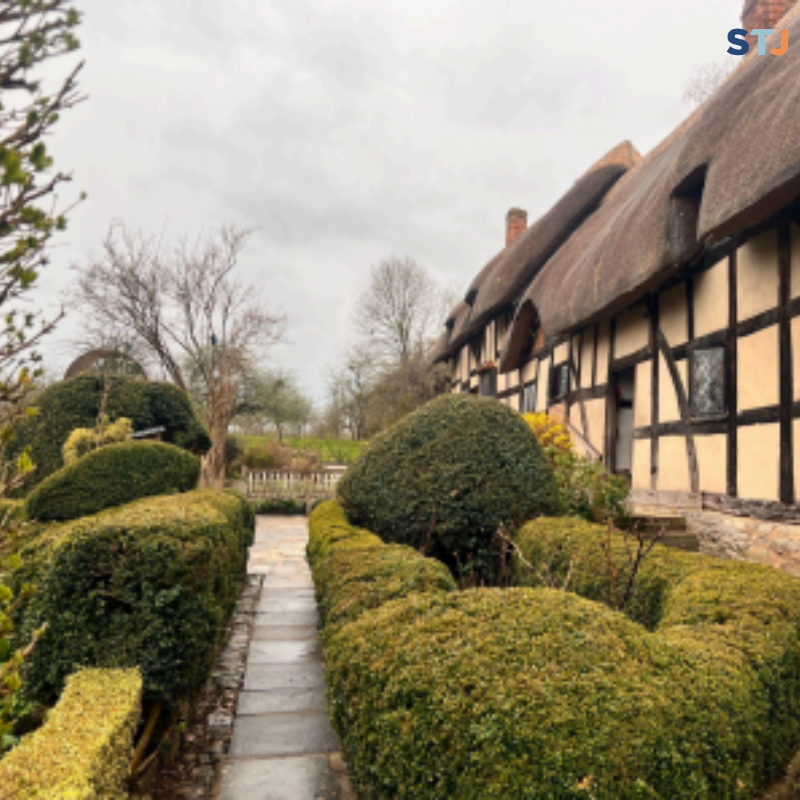
My journey begins at Anne Hathaway’s Cottage, a place I call The Sanctuary. While the film production recreated this world in Herefordshire, the spirit of the story resides here. The standard tour depicts this cottage as a mere house where Shakespeare’s bride had lived before marrying him. Through the lens of the book and the movie, it is both a staging ground for romance and a refuge.
Walking the garden paths, I try to see it as Agnes might have. In the book, the town was a prison, but this garden was her freedom. While the interiors are preserved in their 16th-century gloom, the grounds carry the real essence of the woman. She was a creature of the outdoors who needed to feel the breeze and tend to her plants to make sense of the world. Standing here, away from the town center, you understand the contrast that defined her life: the freedom of this wilder edge of town versus the dullness of the streets she would eventually move to.
Walking into town, I arrive at Shakespeare’s Birthplace on Henley Street.
In 1564, this was two houses; now, it is a museum housing books, documents, and manuscripts. History remembers this as the house where the Bard was born and raised; the novel reframes it as a trap, a prison—the site of both Agnes’s and William’s confinement.
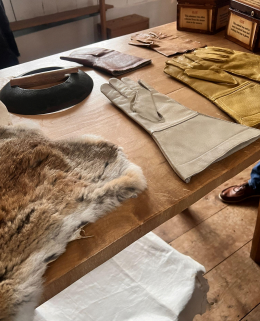
Entering the house, the air feels different. As I squeeze through the narrow corridors and small rooms with a dozen other tourists, the suffocating atmosphere described in Hamnet becomes palpable. The rooms feel small, the ceilings low. You can understand why Agnes and William would dream of escaping this density. This was more than a home; it was a glover’s workshop. A couple of gloves are displayed on a table, and looking at them, you can almost smell the scent of treated leather.
A short walk away, the narrative of the town shifts from struggle to silence. New Place was the grand family home Shakespeare bought in 1597, but the house itself was demolished in 1759. Today, it is a registered garden. This absence is powerful. In O’Farrell’s telling, the purchase of this house is Willam’s gesture to compensate for his absence. It is also an act of grief; an attempt to move Agnes out of the Henley Street home where every corner held a memory of their dead son. Standing in the garden, surrounded by sculptures, the emptiness feels heavy. It is a space defined by absence: a missing house, a lost son, and a husband often
missing in London.
My final stop is where the tour must end: Holy Trinity Church. However, I am not interested in visiting the altar where Shakespeare is buried. In search of a different spot, I walk out to the churchyard. I see two rowan trees, planted in 2022 as a memorial to the twins, Hamnet and Judith, because their actual graves are unmarked.
Leaving the church, I pass the Royal Shakespeare Company theatres, where Hamlet is performed again and again, keeping the boy’s name alive in the mouths of actors who never knew him. Stratford-upon-Avon has always been known as the “birthplace of Shakespeare.” But walking its streets now, with the story of Hamnet in mind, it transforms into a landscape of a family’s joy and their insurmountable grief. We come looking for the history and stay for the emotional connection to a boy who never grew up, and a family who survived grief, each in their own way.
On Location: The Hamnet Film Trail If you are looking for the cinematic “Stratford,” you will need to travel to Herefordshire. The film production used Cwmmau Farmhouse and Weobley village to stand in for the Hathaway farm and 16th-century Stratford streets.
Places you can add to your itinerary:
Shakespeare’s Schoolroom & Guildhall Just steps from the Birthplace, this immersive medieval guildhall offers a glimpse of where Shakespeare attended school.
This article is part of the practical work carried out by students on the Master’s Degree in Travel Journalism at the School of Travel Journalism.