By Bistra Yakimova
Deep into the Nordic night, with hopes of spotting the Aurora Borealis, I arrived in Balestrand, a village so small it could fit inside one Norwegian fjord and still leave space for your thoughts to echo. I came here first for a training course and later returned for a second one, though, truthfully, I think I came back because I had fallen in love.
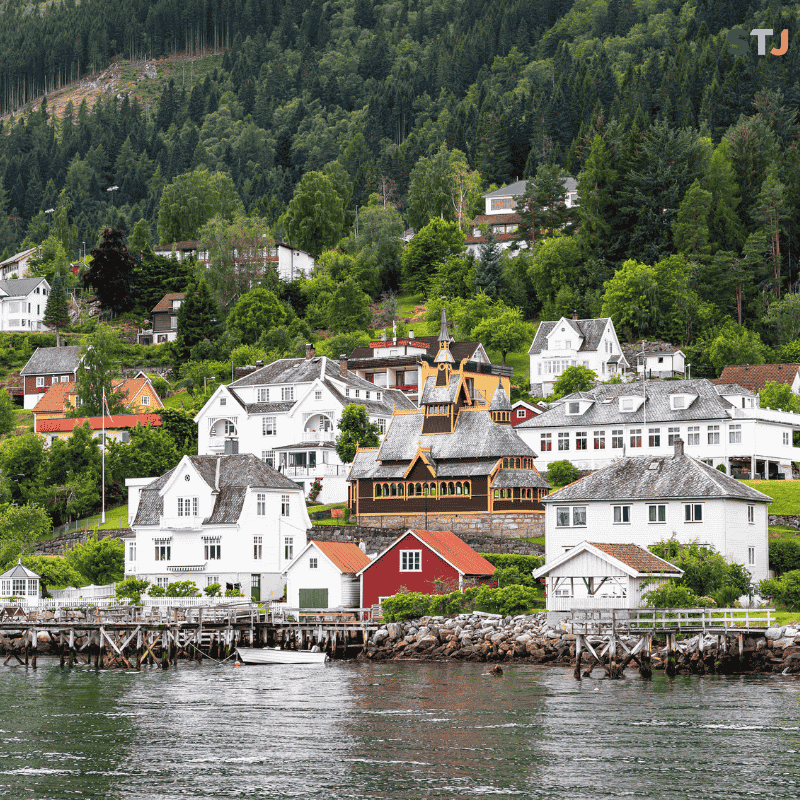
It’s hard not to. Balestrand is the kind of place that reminds you how much beauty exists when people choose to live gently with nature. The fjord glimmers like liquid glass, reflecting pastel, colored houses that stand shoulder to shoulder as if guarding a secret. Every window holds small treasures, mismatched ceramics and second-hand finds from the village’s tiny shop, each object a piece of someone’s story.
Afternoons in Balestrand are best left unplanned. You might wander along the pebbled shore or sit by a window with a book, the sound of seagulls drifting in. Or you might end up deep in conversation with the international group from the course — talks that start with travel but wander into life, hope, and how to make sense of the world. Here, both silence and connection feel equally fulfilling.
The locals always greet you, no matter how many times you pass the same road. There’s a quiet kindness about them, as if they know that being surrounded by so much beauty requires gratitude. One special afternoon, I walked what locals call the “Villa Road”, a winding path lined with wooden houses painted in warm yellows and soft blues. The road leads to Ciderhuset — the local cider house and apple farm run by Tuba and her family. The air there has the crisp sweetness of apples, and the cool cellar smells like autumn. Tuba tells stories while pouring cider — how the family started with a few apple trees, how each harvest still feels like a celebration. Over a dinner of fresh ingredients spiced with flavors from around the world, I realized that what they cultivate is more than fruit — it’s continuity, care, and a kind of hospitality that roots you to the place.
Balestrand has always drawn storytellers. Painters came for its soft northern light; musicians still gather for festivals that defy description. Once, I stumbled into a musical-experiential event where we listened to poetry to the sound of shrimps recorded underwater and watched a broken guitar “play” with the help of a banana peel. It sounds absurd — and it was — but in that absurdity was something beautiful: a reminder that creativity thrives wherever people remain curious.
The village is also a mosaic of love stories. The most famous belongs to Knut Kvikne and Margaret Sophia Green. She was an English woman who came to Balestrand in the 1890s, fell in love with Knut — and with Norway — and asked him to build her a church in English style. When she died young, Knut kept his promise. The result is St. Olaf’s Church, a small wooden miracle perched above the fjord, filled with light that seems to come from the inside out. It’s a story that still hums through the village, reminding you that love can build something lasting even after loss.
But there’s another, older legend that hovers around Balestrand — that of Fridtjof the Bold and Ingebjørg the Beautiful, whose love defied kings and kingdoms. Their saga was painted, sung, and retold by countless artists who came here seeking the landscapes that once inspired Vikings. Walking by the fjord, it’s easy to imagine them — two silhouettes on opposite shores, waiting for the wind to shift in their favor.
Maybe that’s what Balestrand does: it reminds you to wait for the wind, to listen, to notice. The stillness here isn’t empty; it’s full of echoes — stories of love, of resilience, of people who never stopped believing in the harmony between life and nature.
On my last evening, I stood by the water, watching the sky dissolve from gold to indigo. The air carried the scent of rain-soaked leaves — that quiet perfume of endings and renewal. My thoughts, usually restless, finally fell quiet. Balestrand didn’t ask for anything — it simply showed how care, love, and respect could coexist in one small corner of the world. And in that calm, I found myself falling in love not only with the village but with the possibility that people can still care enough to protect what is beautiful.
In the end, maybe that’s what travel should do — not just show us new places, but help us return to the parts of ourselves that still believe in wonder. And if you ever find yourself on the edge of a fjord, somewhere between myth and mist, you’ll understand: falling for Balestrand is inevitable.
This article is part of the practical work carried out by students on the Master’s Degree in Travel Journalism at the School of Travel Journalism.