By Cristina Navarro Avilés
When I teach food photography, one of the things I repeat most often is that studying other photographers does not mean copying them. It means learning to read decisions. That is exactly why I want to share the food photographers I think are worth studying: not as a ranking to admire, but as a way to train your eye.
A picture of food is never just a picture of food. It can speak about a place, a way of cooking, a brand, a long lunch with friends, a whole culture, or one very specific way of looking at the world. So when we study the work of other photographers, I am not interested in stopping at whether an image “looks nice.” I am interested in asking why it works. What light holds that mood. What has been deliberately left out of the frame. What role texture is playing. What emotion is being built.
In my classes I keep coming back to one idea: lifestyle food photography should show a well-presented dish, yes, but it should also tell stories, convey sensations, and reveal the relationship between people and what they eat. Looking at other photographers is useful precisely because it teaches you how images are constructed, how light, color and composition are used to move someone.
This list is not ordered from best to worst. It works more like a map of possible ways of seeing. Some photographers build their work from natural light and freshness. Others from total studio control. Others from emotion, color, imperfection, atmosphere or commercial precision. Every one of them can teach something to anyone learning food photography.
Cristina Navarro: product, restaurant and a narrative eye
I am putting myself at the start with a certain amount of awkwardness, because a list of references can easily sound like a ranking, and that is not what I am after. I do it for a more honest reason: this selection comes directly from the way I teach.
I work across several territories: food photography for restaurants, food product photography, commercial campaigns, packaging and lifestyle scenes. In my case, photography often moves between two needs that seem to pull in opposite directions: controlling the image very tightly and, at the same time, letting it feel alive.
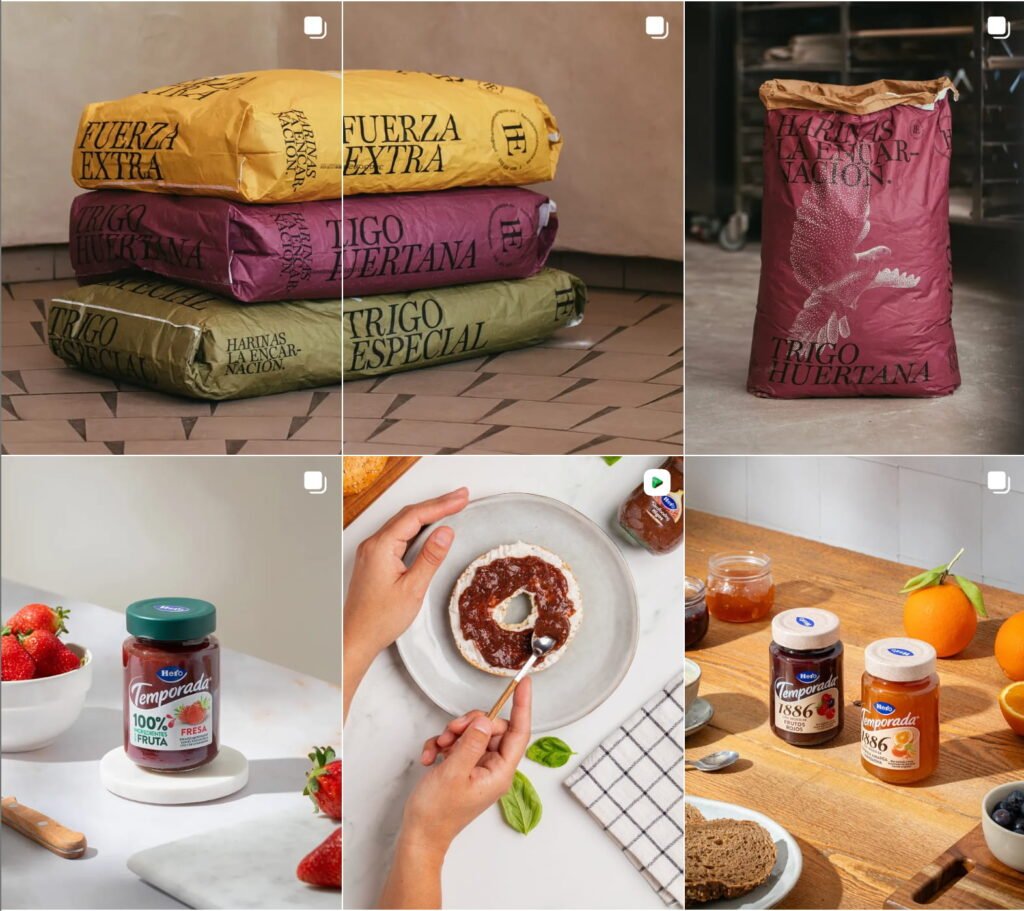
Food product photography by Cristina Navarro
When I shoot product for a brand, everything matters: shape, volume, color, legibility, the final use of the image. A packaging photograph, for example, has to work on an actual container, sit alongside graphic design, and communicate clearly what the product is. When I step into a kitchen or a restaurant, though, I cannot treat the scene like a still, frozen tabletop. There is rhythm, there are people, steam, hands, noise, things that go wrong. There the image needs room to breathe.
My professional work moves between product, food, packaging and editorial photography, with projects for brands, agencies and clients across Spain, including some of the country’s largest food and retail names such as Mercadona, Eroski and ElPozo.
What I want my students to study is not an aesthetic formula but a way of deciding: when to control, when to wait, when to clean up a scene, and when to accept an imperfection because it tells the truth of the place better.
Where to see my work: Website | Instagram
Àlex Froloff: photographing the desire to live an experience
Àlex Froloff is one of the photographers I find most useful to study if you want to understand restaurant photography from a contemporary, commercial and very digital-first point of view.
His line, “I don’t photograph food, I photograph the desire to live it,” sums up his approach well. In his images, the dish never appears cut off from the experience around it. There is texture, appetite, directed light, detail, atmosphere, the kitchen, the dining room, and above all a very clear intention: to make the viewer want to be there.
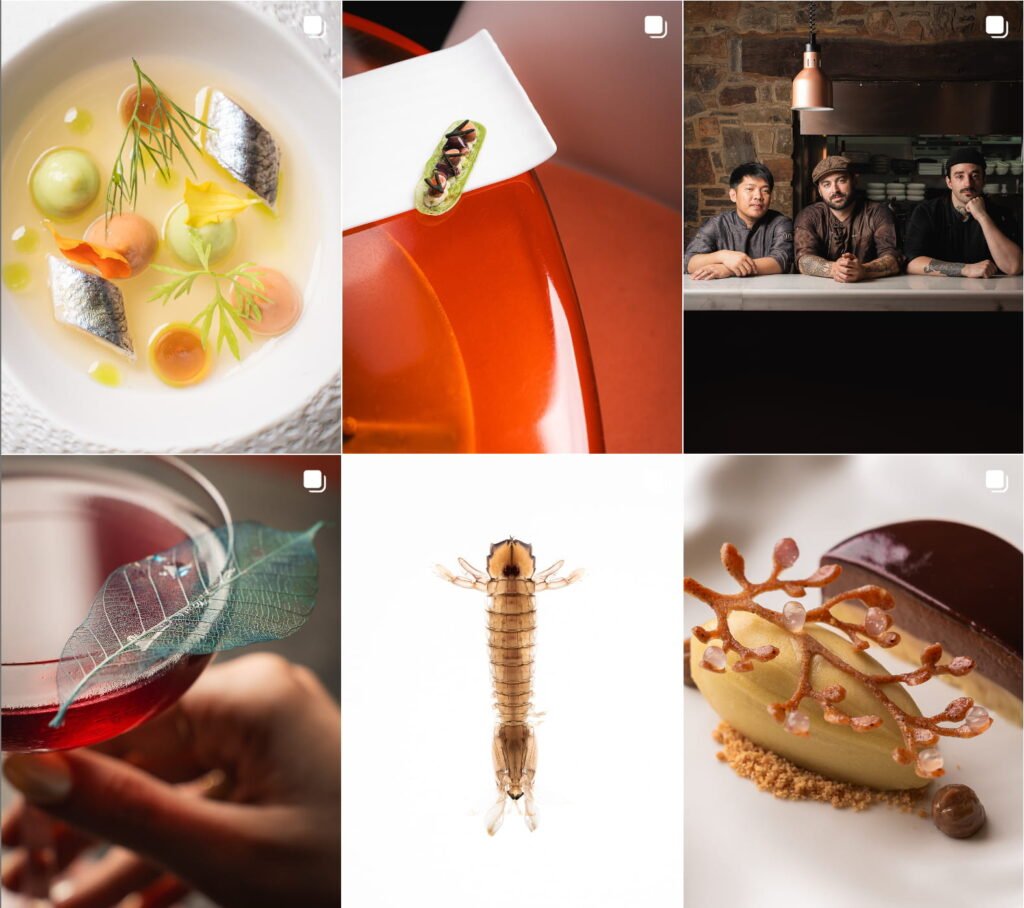
Àlex Froloff specialises in restaurant photography
Based in Barcelona, his work has spread to other regions too. On his own site he describes more than 300 restaurants photographed over the past few years, and he also runs one-to-one mentoring for photographers who want to turn their work into a profession.
I find him especially valuable for students because he ties together three layers that are now inseparable: craft, business and visual language. He commands portable artificial light, color and editing, and builds image banks that restaurants can actually use. But the point is not only the technique. The point is that he understands a restaurant needs images that can live on a website, on social media, in the press, on the menu, in campaigns and across a brand.
From Àlex I would learn to think about the whole shoot, not the single hero shot: dishes, kitchen, portraits, interiors, details, pairings, gestures and atmosphere.
Where to see his work: Website | Instagram
David Loftus: freshness, intimacy and side light
David Loftus is one of those food photographers whose work has shaped the visual imagination of countless people, even when they do not know his name. He is best known for his long collaboration with Jamie Oliver and for a way of photographing food that feels close, appetising and very human.
His official site presents him as an internationally recognised, highly influential photographer, with images for books by Jamie Oliver, Rachel Khoo, Gennaro Contaldo, Elizabeth David and April Bloomfield, among others. He has photographed more than 100 books, including almost all of Jamie Oliver’s international best sellers.
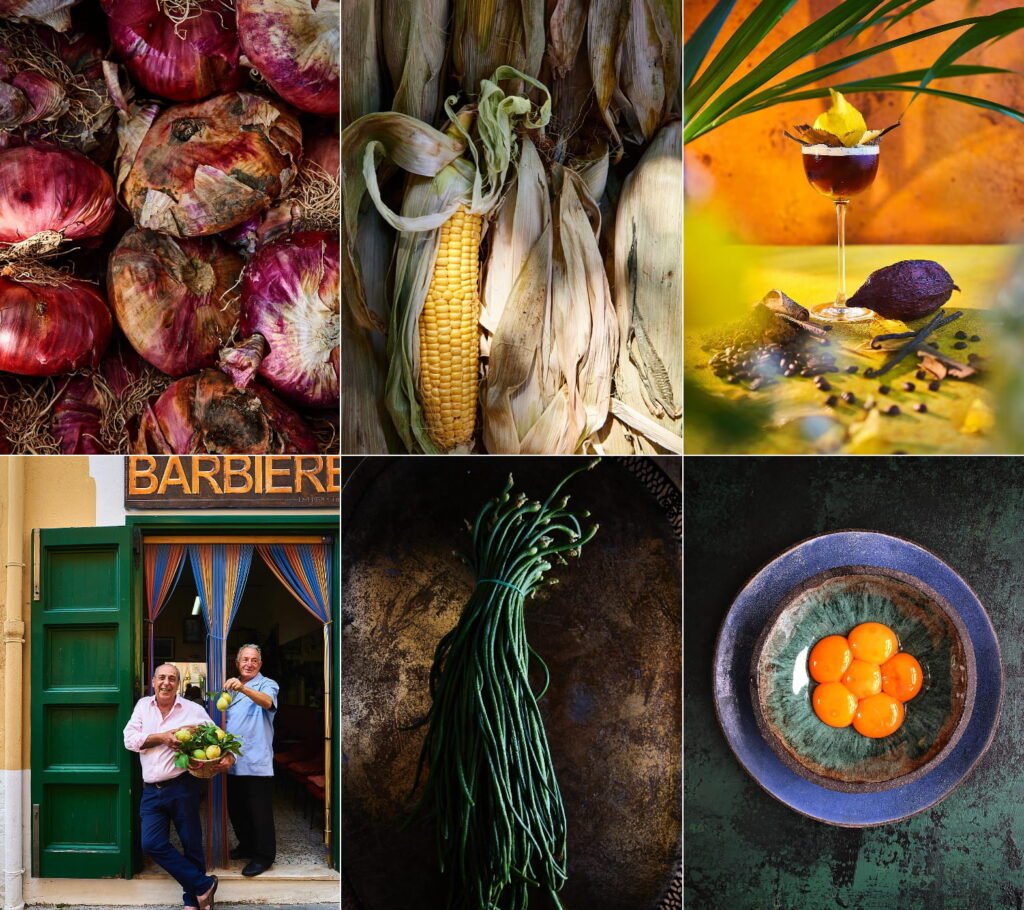
Food photography by David Loftus
In class I study him for his ability to make an image look simple without being simplistic. That is an important difference. His photographs tend to use side light, direct compositions, color, freshness and a sense of food that is real, shareable and close. The hard part of that naturalness is keeping it from looking careless. Loftus shows that an editorial photograph can be very accessible without losing intention. There are dishes, hands, tables, ingredients, backgrounds that breathe. The aim is not to impress with artifice but to make the food feel alive.
From him I would learn to trust simplicity when it is well built.
Where to see his work: Website | Instagram
Bea Lubas: delicacy, emotion and everyday poetry
Bea Lubas works from a very different place. Her food photography has something intimate, delicate and emotional about it. She is not only showing a dish, she is building a small scene where light, textures and objects seem to carry memory.
On her site she presents herself as an internationally recognised food photographer, author and Lightroom Ambassador, known for her attention to detail, her exploration of light and her storytelling images. She lists publications, brand projects and awards such as Pink Lady Food Photographer of the Year and the UK Blog Awards.
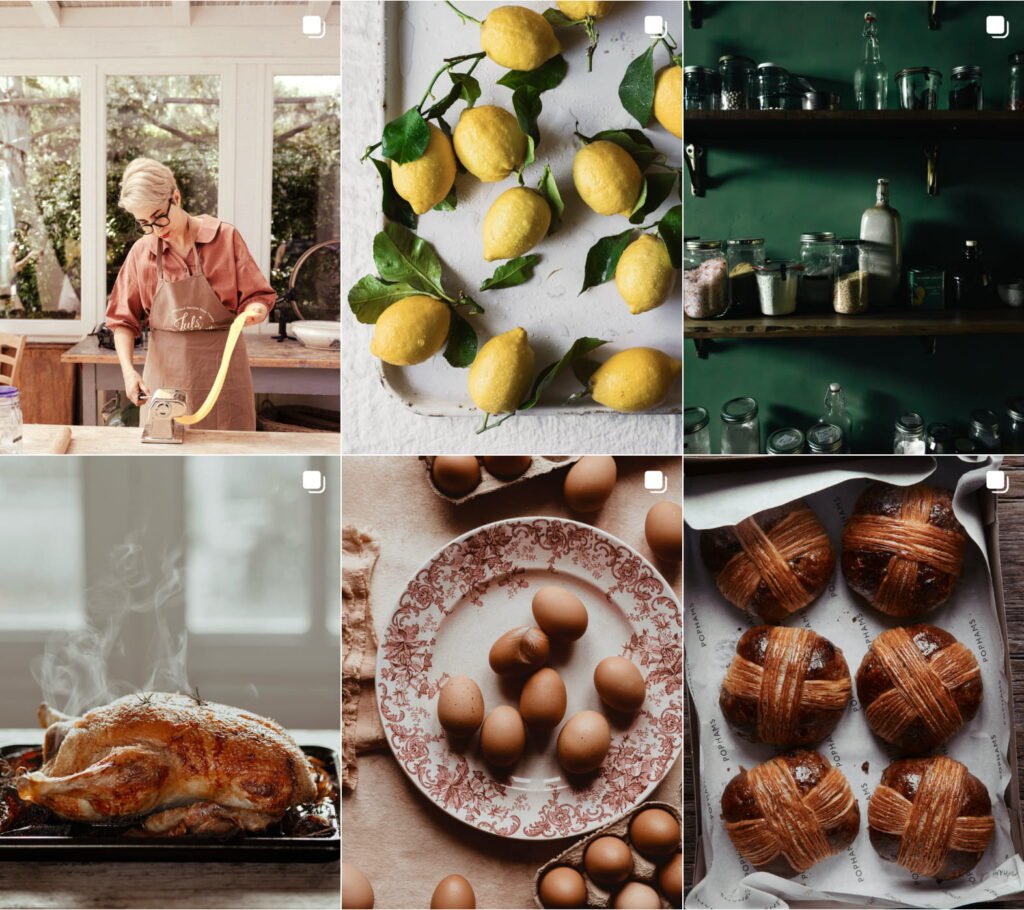
Food photography from Bea Lubas’ Instagram
I am drawn to her work because it teaches you to look at the everyday with more care. In her images, a piece of fruit, a dough, a table or a shadow is not a decorative element. It has presence. There is a clear sensitivity toward the material itself: the skin of an apricot, the crumb of a loaf, the steam, the tablecloth, the rim of a plate.
Her style is useful for anyone who wants to work in lifestyle food photography without falling into empty set design. The emotion does not come from piling on objects, but from each thing seeming to be exactly where it belongs.
From Bea I would learn to slow down and observe the details before moving anything.
Where to see her work: Website | Instagram
David Jilkyns: technical control with a commercial soul
David Jilkyns is a fascinating reference for anyone who wants to understand the more technical side of food and product photography. His work has an obvious precision: he controls light, texture, color and composition with a lot of intention.
He is a specialist in editorial and advertising food photography, with real command of color, texture, technical composition and artificial light. He is also widely followed on YouTube thanks to his photography tutorials, and his channel is built precisely around teaching food, drink and product photography in a clear way.
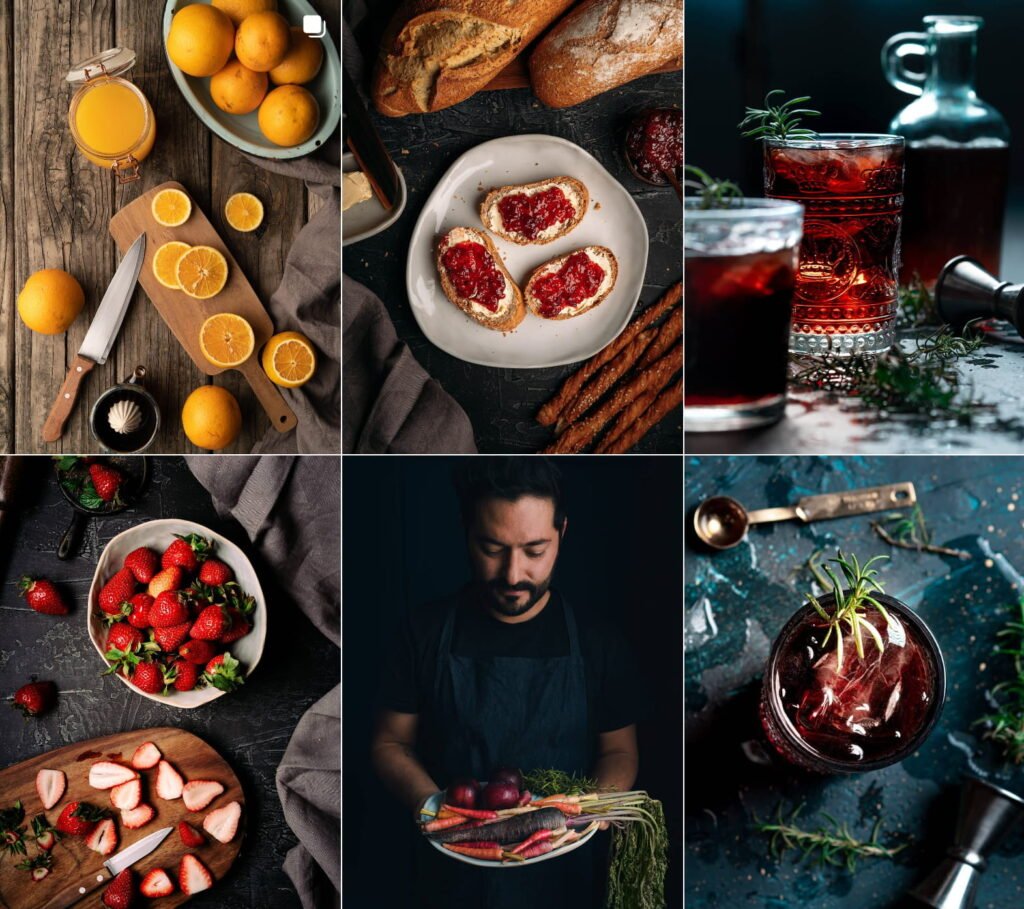
David Jilkyns, specialist in dark food photography
What interests me about Jilkyns is that he dismantles the idea that commercial work has to be cold. Advertising photography can be extremely precise and still have character. In his case, the liquids, drinks, highlights, textures and backgrounds are all worked with a very clear purpose.
For a student, studying his work helps clarify something essential: artificial light is not the enemy of naturalness. It all depends on how it is used and what for. Sometimes an image needs control in order to be appetising, legible and effective.
From him I would learn not to be afraid of building light from scratch.
Where to see his work: Website | Instagram
Joanie Simon: learning food photography without losing the play
Joanie Simon, creator of The Bite Shot, is an especially useful reference for students because she has turned teaching food photography into an accessible, practical and very visual language.
The Bite Shot is built as a place to learn food photography from scratch, with resources on camera, professional lighting, dynamic compositions and the business side. Joanie is a commercial food photographer, published author and educator who specialises in explaining difficult photography concepts in an easy way.
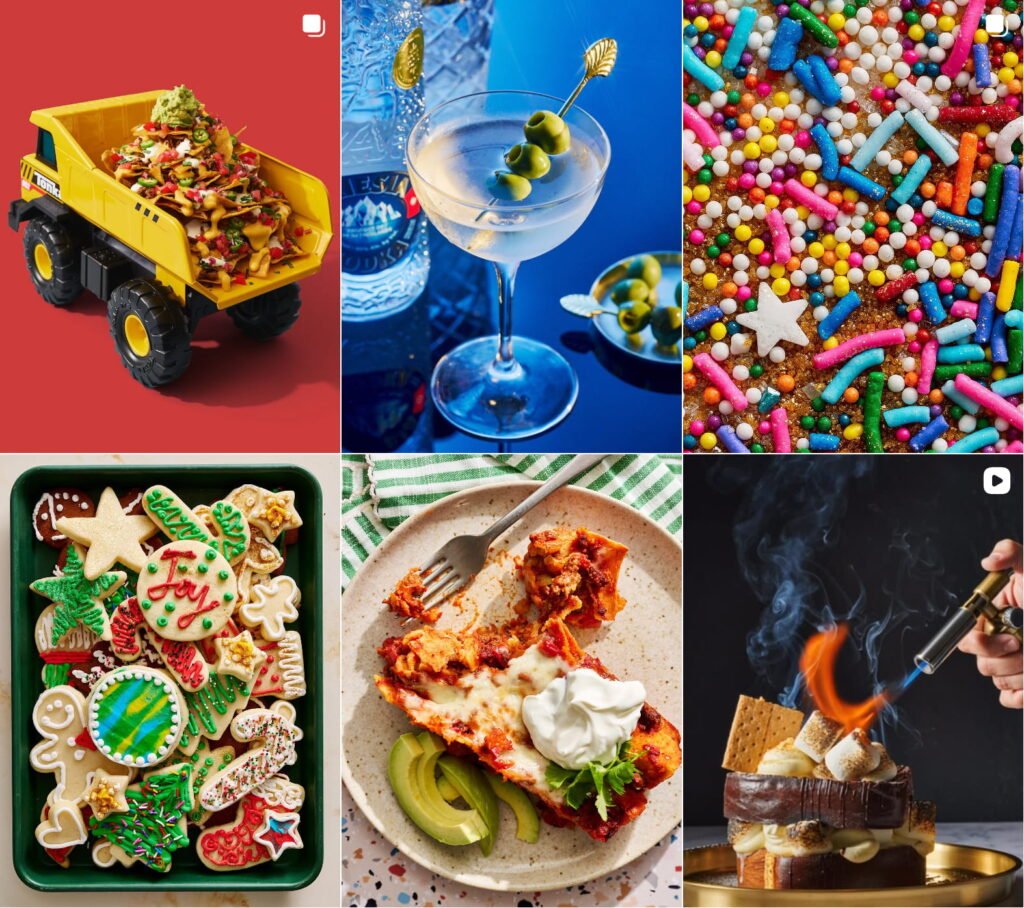
Joanie Simon, commercial food photographer
I like her profile because it combines two things that do not always go together: technical rigor and a desire to experiment. Her work helps you understand artificial lighting, backgrounds, color, composition and small production tricks without turning photography into something intimidating.
For a student, Joanie can be a great way into actual practice. Not because everything has to be done her way, but because she teaches you to try things. To move a light. To swap a background. To understand what happens when you raise or lower a source. To watch how a highlight behaves on a sauce, or how a dish changes with the angle.
From her I would learn to experiment without losing clarity.
Where to see her work: Website | Instagram
Linda Lomelino: chiaroscuro, baking and atmosphere
Linda Lomelino has a very recognisable visual universe. Her photography is poetic, elegant and deeply tied to chiaroscuro, color and atmosphere. She is an especially interesting reference for anyone working with baking, romantic scenes, or images where food is part of a more sensory world.
A Swedish photographer, author of the blog Call Me Cupcake and of four books published in several languages, she also offers photography, food styling, content creation, recipe development, video and creative workshops.
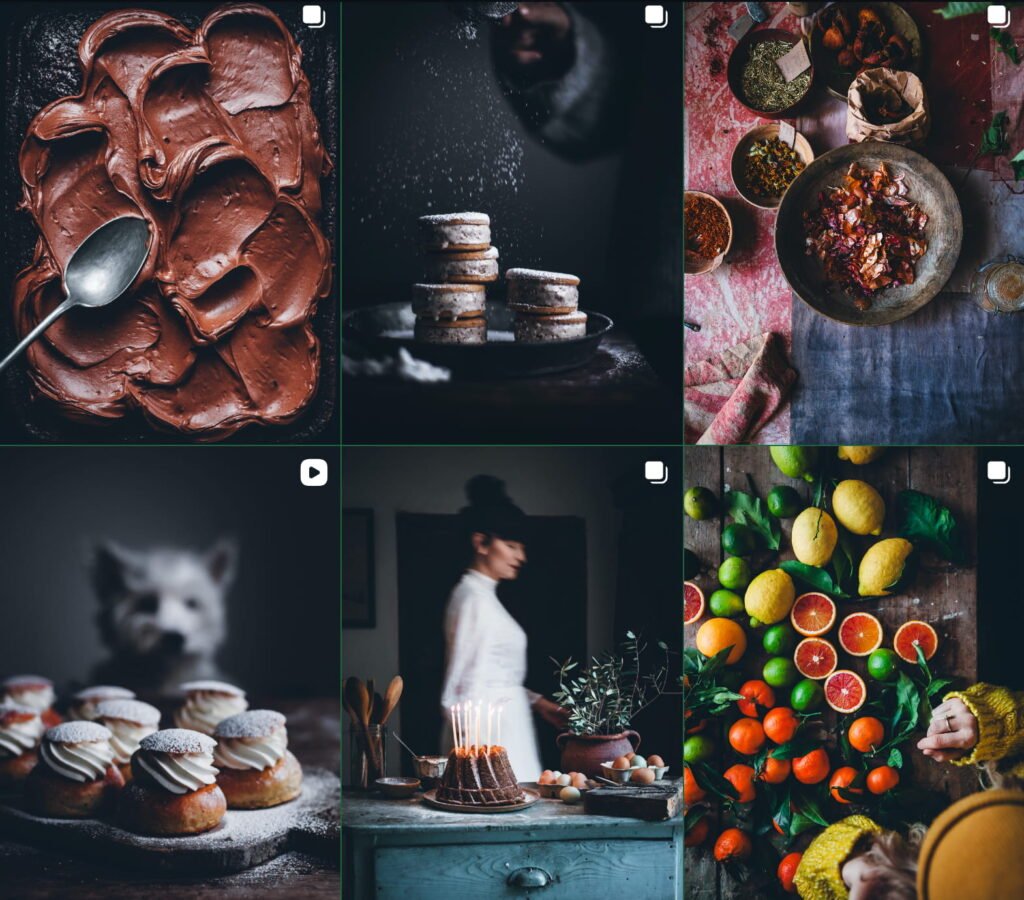
Food photography by Linda Lomelino
In class we study her use of soft side light, cool tones, delicate compositions and a very poetic style. The interesting thing is that her work does not need to shout. Many of her images work through restraint: shadows, flowers, fruit, cakes, dark backgrounds, deep colors, minimal gestures.
It is not a style to apply without thinking. Copy only the surface and it can turn merely decorative. Study it properly, though, and it teaches a great deal about how to build a coherent atmosphere.
From Linda I would learn to use shadow as part of the story, rather than as something that always needs correcting.
Where to see her work: Website | Instagram
Matt Armendariz: color, energy and commercial language
Matt Armendariz represents a bright, vibrant food photography that is closely tied to the American editorial and advertising tradition. His work has color, optimism, energy and a real talent for making food look desirable without losing momentum.
He describes himself as a photographer, communicator and image-maker with more than 30 years of experience. He has worked on New York Times best-selling books and with agencies, retailers, authors, publishers and food brands, and he sums up his own images as bold and vibrant work that balances authenticity and visual appeal.
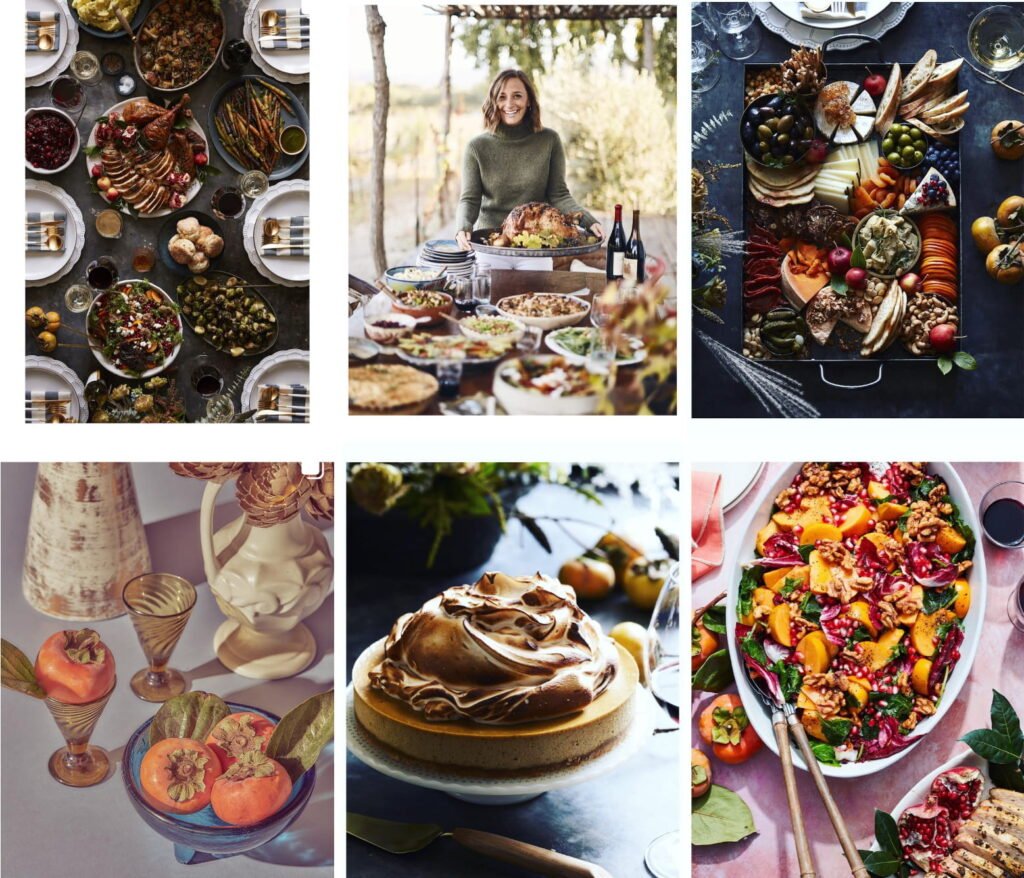
Food photography from Matt Armendariz’ Instagram
I am interested in him because his photography proves that commercial does not have to mean flat. It can be luminous, playful, graphic and beautifully crafted. His images tend to handle the relationship between color, shape and appetite very well, with a clear inheritance from design and art direction.
For students, Matt is great for studying how an image full of stimuli stays organised instead of becoming chaotic. How color backgrounds are used. How a cheerful composition is balanced. How you build a photograph designed to sell without it looking like nothing more than an ad.
From him I would learn to take color seriously.
Where to see his work: Website | Instagram
Mowie Kay: editorial sophistication and emotional precision
Mowie Kay works from a very clean kind of sophistication. His images have technical precision, attention to texture and an editorial elegance that never feels forced. There is naturalness, but also a great deal of control.
His approach is described as fresh and sophisticated, with contemporary images that capture his love of natural light and good food. Working from his studio in south London, he operates across advertising, editorial and packaging, collaborating with brands and publications such as Marks & Spencer, Waitrose, Harrods, Tesco, The Wall Street Journal, Food & Travel, Delicious and Olive.
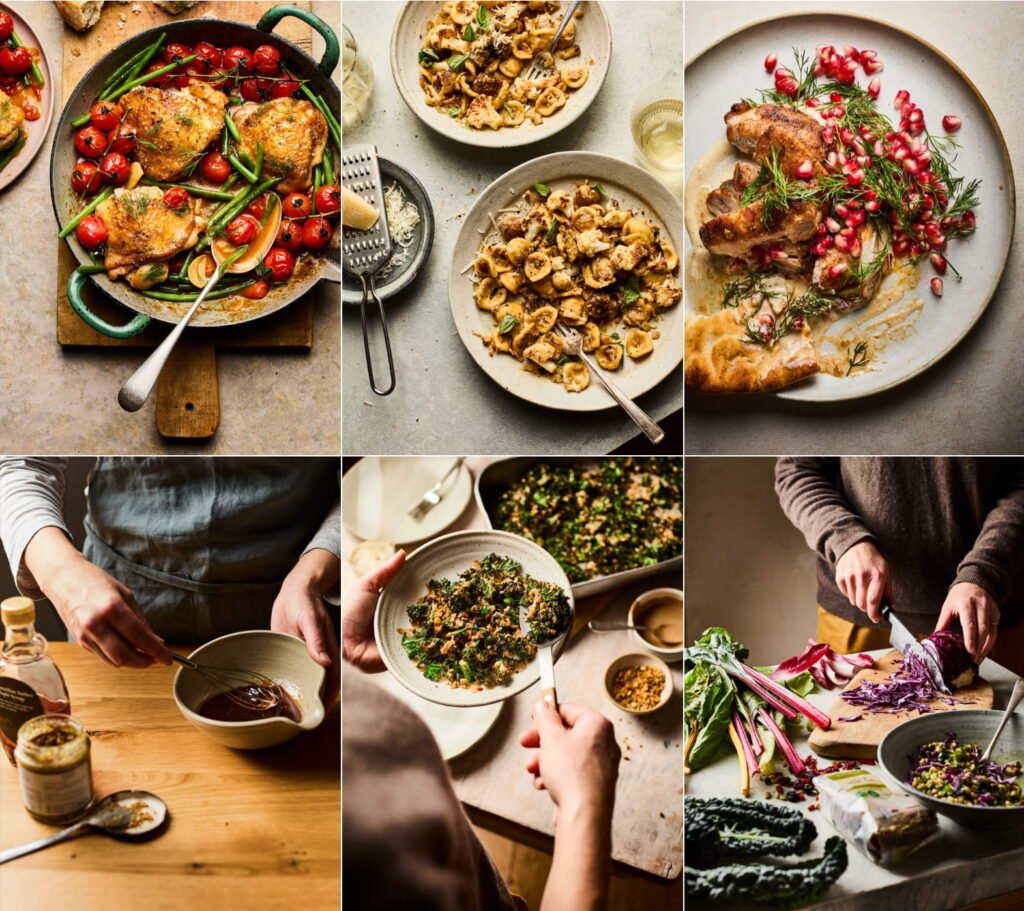
Food images by Mowie Kay
In class I use him as an example of sophisticated editorial style: clean light, natural colors and an extreme attention to texture. The interesting part is that it never reads as cold sophistication. There is care, but there is also appetite. There is order, but no rigidity.
For a student, Mowie teaches you to look at texture with precision: the crust, the skin, the highlight, the surface of a sauce, the volume of a dough. He also teaches something important about consistency across a series. His images work individually, but together they build a coherent visual world.
From him I would learn to be demanding without erasing the emotion.
Where to see his work: Website | Instagram
Marte Marie Forsberg: narrative, nostalgia and a painterly eye
Marte Marie Forsberg works from atmosphere. Her images feel like they belong to a bigger story that is never fully told. There is natural light, muted tones, nostalgia, countryside, interiors, food, hands, flowers, tables, and a very strong presence of time.
A photographer and author originally from Norway, with ties to the English countryside and to Florence, her work has appeared in publications such as Bon Appétit, Food & Wine, Elle, Table Magazine, The English Home and House & Garden, and she has spent years teaching photography workshops across Europe.
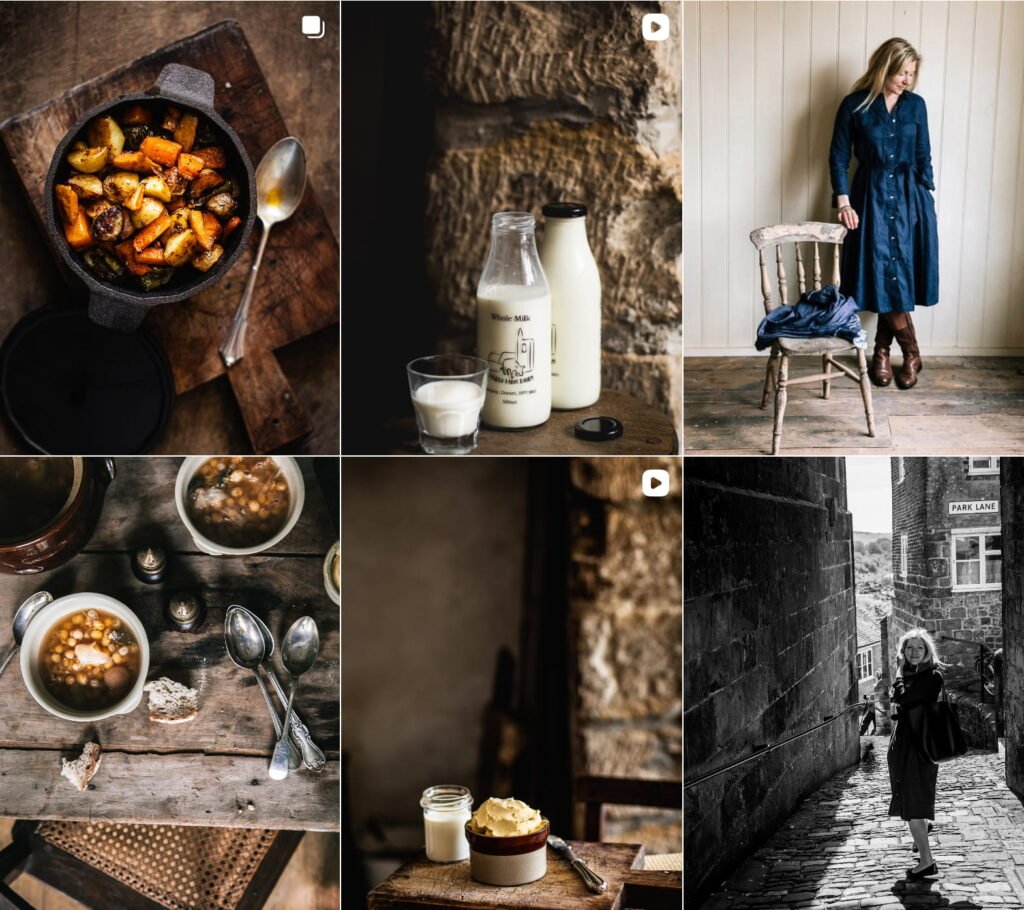
Images by photographer Marte Marie Forsberg
In class she stands as a photographer focused on atmosphere and visual narrative, with images that feel like part of a story: natural light, muted tones and a strongly painterly style.
Studying Marte Marie helps you understand that food photography can also have an almost literary dimension. Not everything has to be immediate. Not everything has to look perfect. Sometimes an image works because it suggests more than it shows.
From her I would learn to build silence inside a photograph.
Where to see her work: Website | Instagram
How to study these photographers without copying them
When I ask my students to look at food photography references, I am not asking them to build a folder of pretty pictures. I am asking them to learn to read.
First, I would look at the light. Where is it coming from? Is it natural, artificial or a mix? Is it softened? Does it create volume or flatten the scene? Is it going for realism or dramatising the moment?
Then I would study the composition. Not just whether it follows a rule, but how it guides the eye. Where the visual weight sits. Which elements are unnecessary. What has been left out. What role the empty space plays.
I would also pay attention to color. Some photographers work with warm palettes, others with cool tones, others with vibrant colors and others with muted ranges. Color is not decoration. It is a narrative decision.
Next I would look at human presence. Hands, bodies, gestures, movement, leftovers, imperfections. In lifestyle food photography, the human element does not always need a face. Sometimes a hand serving, a used napkin or a half-cleared table is enough.
And finally I would watch for consistency. A single photograph can be brilliant, but a real way of seeing reveals itself across a series. That is where you truly understand how a photographer thinks: what they repeat, what they avoid, what kind of world they build.
Studying references should not lead us to imitate styles, but to ask ourselves better questions. Because in the end, before you press the shutter there is always a decision: what I want to tell, where I am looking from, and which part of reality deserves to stay inside the frame.
This article was written by Cristina Navarro, professor of food photography in the Master in Travel Journalism and the Master in Gastronomic Journalism and Communication at the School of Travel Journalism.
Want to learn to read images like this and tell stories through food? This way of looking is exactly what we practice in our Master in Gastronomic Journalism and Communication. If you would rather start with the wider craft of travel storytelling, the Travel Journalism Intensive Program is a good first step.