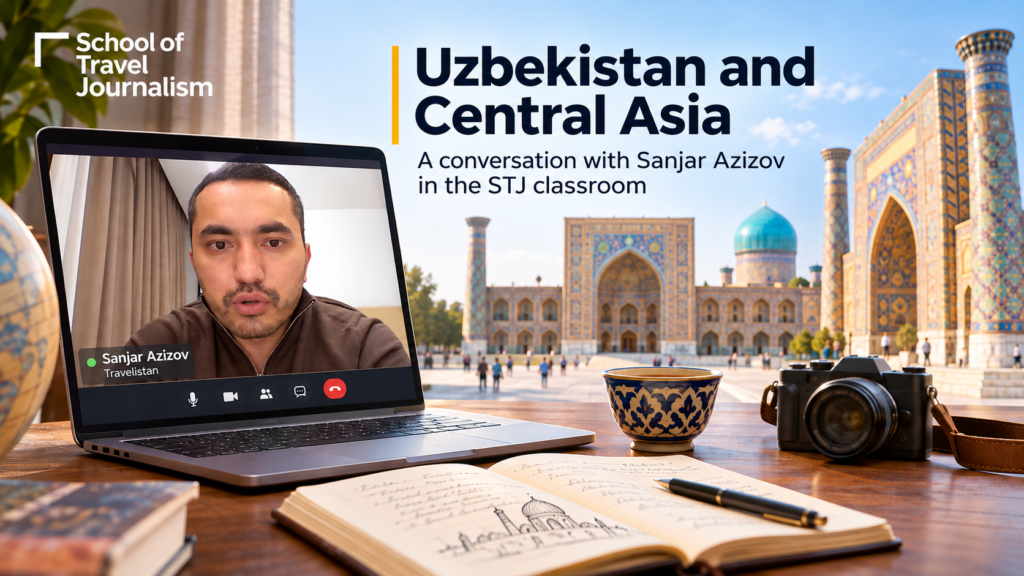
On the evening of 3 November, the virtual classroom of the School of Travel Journalism travelled to Central Asia. Our guest was Sanjar Azizov, founder and owner of Travelistan, a company based in Uzbekistan that designs and runs trips across the five “-stans”: Kazakhstan, Kyrgyzstan, Tajikistan, Turkmenistan and Uzbekistan. The session brought together students from our Master in Travel Journalism cohorts, together with students from our gastronomy programmes.
Why we invite destinations and companies into the classroom
At STJ we are 100% online, but we believe in learning by seeing the industry up close. Theory on journalism, content creation, branding and marketing matters, but it is not enough. That is why we regularly open our classroom to destinations, tourism companies and professionals who work in the sector every day, so that students can listen, question and challenge them as journalists would.
This masterclass had a personal origin. A former STJ student travelled to Uzbekistan for her Final Master Project and returned with excellent content. Her work made us curious to know more about the country, and about the people who make it travel-ready.
A country on the rise along the Silk Road
Sanjar began with the essentials. Uzbekistan has more than 40 million inhabitants, has been independent since 1991, and sits at the very centre of the old Silk Road. Citizens of many countries, including most of Europe, can now enter visa-free for up to 30 days, a change he identified as one of the keys to the destination’s boom.
His presentation then took us on a route through the country’s great cities:
- Tashkent, the modern capital, whose name means “city of stone”, and the gateway for most visitors.
- Nukus and the Aral Sea, where an extraordinary art museum stands in the middle of the desert and the “ship cemetery” tells one of the great environmental stories of the 20th century.
- Khiva, an open-air museum city and UNESCO World Heritage Site inside its walled fortress, Ichan Kala.
- Bukhara, the “holy city of Central Asia”, where building in the old town is limited to two floors, so most hotels are small boutique properties.
- Samarkand, the cradle of Tamerlane, with the Registan Square, the Gur-e-Amir mausoleum and the observatory of Ulugh Beg.
He also showed the less obvious side of the country: yurt stays in Nurata, the Buddhist heritage of Termez and the ceramics and silk of the Fergana Valley.
Food, craft and culture
Our gastronomy students had plenty to take away. Sanjar described plov, the national dish of rice, carrot and meat, as a food that changes from region to region: richer and heavier in Tashkent, lighter in Bukhara, Khiva and Samarkand. He also spoke of handmade suzani textiles, silk, carpets and local folk traditions. Among his experiences for travellers, he highlighted cooking with a family in a village and tasting local wines.
The questions that make a journalist
The most valuable part of the evening was the discussion. Our students asked the questions that a travel journalist should ask:
- What is the price of growth? Sanjar was candid: in high season, hotels and monuments are full, and the country is not yet fully ready for so many visitors. He admitted he worries about losing some of the destination’s uniqueness. His advice for travellers: stay at least two days in each city and ask locals where they eat, rather than choosing tourist restaurants.
- Who benefits from the boom? Students asked about large hotel chains, local businesses, national wealth and social issues such as human trafficking. Sanjar offered his own view as a tourism professional, and our students did what journalists do: they noted his answers as one voice that should be contrasted with independent sources.
- How resilient is the destination? He explained that European visitors, mostly from Spain, Italy, France, Germany and the UK, kept travelling this year despite regional conflicts, although fuel and travel costs rose.
- What should a visitor know? Drones require prior permission, visitors dress modestly in mosques and madrasas, and English is widely spoken in tourist areas.
Beyond the classroom
Sanjar told us that Travelistan attends FITUR in Madrid every year, so students visiting the fair will have a chance to meet him in person. STJ also takes students into the field: this year a delegation travelled to the Art & Tur festival in Ovar, Portugal, to interview industry professionals.
We are grateful to Sanjar Azizov and Travelistan for their time, openness and generosity, and to our students for their curiosity and sharp questions. Sessions like this one are part of our commitment: that those who study at STJ meet the real travel and gastronomy industry before they step into it.