When a Japanese town cancels its cherry blossom festival because visitors have overwhelmed the neighbourhood, who is responsible? The journalist who wrote about it? The influencer who photographed it? The tourist board that promoted it? Or the traveller who simply turned up?
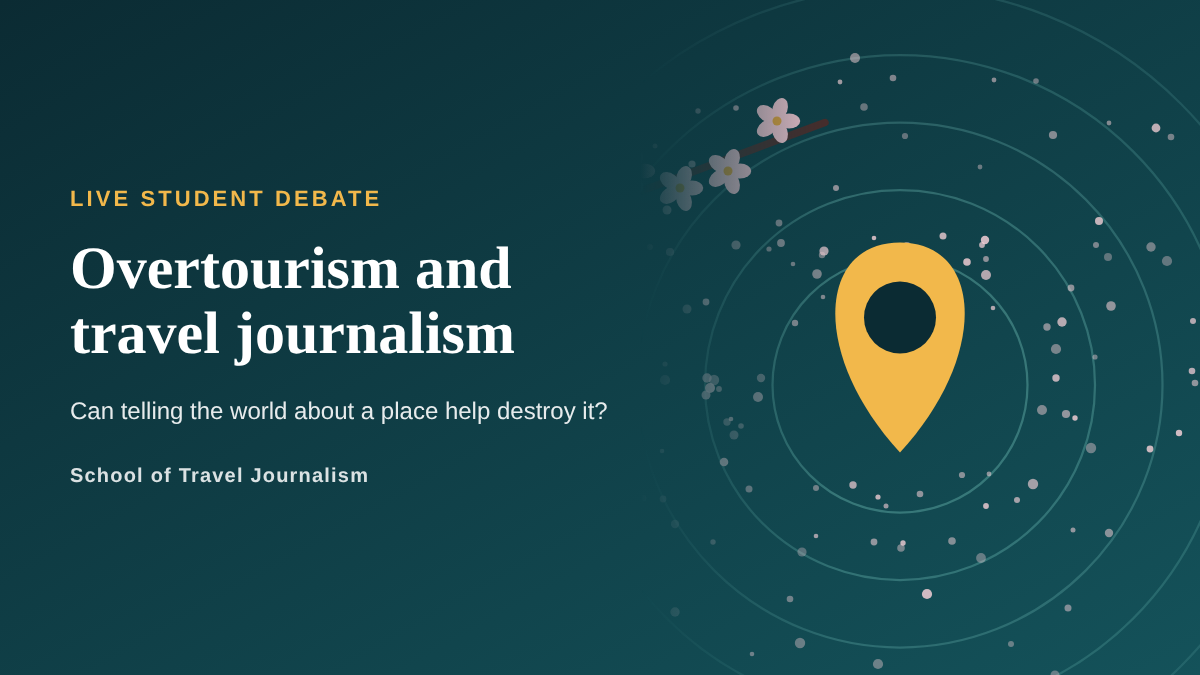
That was the starting point of a live debate on overtourism and travel journalism, staged on Monday 9 November by students of our Master in Travel Journalism (February 2026 intake). The question on the table was a hard one for anyone who writes about travel: can telling the world about a destination ultimately contribute to its destruction?
A debate produced by students, from the first email to the last slide
Everything you could see on screen was planned and run by the students themselves. Fiona MacKellar moderated. Mirna Paul ran production, including an on-screen timer so every answer had the same length. Alina Mina led the research, and Laura Sweeney handled the guests and the invitations, with the support of the rest of the team. The result was a structured debate with four parts: a pro and con round with strict timing, questions from the audience, a case study, and a lightning round.
Their two guests were working travel journalists: Ross Clarke, a travel and food writer who specialises in Wales and Spain, and Catarina Machado, a travel journalist and photographer who focuses on authentic travel and sustainable tourism. Our thanks to both for their time and candour.
Question one: are we just doing our job, or are we part of the problem?
Clarke argued that a journalist’s job is to report the good and the bad, and that a reasoned voice is better than leaving the story to worse sources. He also reminded the audience that tourism is the economic backbone of places such as Benidorm. Machado took a stricter line: there are already too many voices, and journalists should be ready to turn down a contract that promotes a place that is not what it claims to be.
Both agreed that responsibility sits with the writer, whatever the size of the audience. That tension sits at the heart of overtourism and travel journalism.
Question two: who should tell the story of a destination?
Machado described interviewing a local tourist board that insisted tourism brought no problems, only days before residents marched against rising housing costs in the same city. Her conclusion: journalists should hear everyone, but give more weight to the people who live in the place. Clarke added a point that students rarely hear spelled out. Press trips are often funded by tourist boards, so a writer walks a tightrope between paying the bills and keeping editorial independence. Few topics in overtourism and travel journalism raise the question of independence so directly.
Case study: what happens when a place says “enough”
The students then put two real cases to the guests, both at the crossroads of overtourism and travel journalism:
- A cancelled festival. A town near Mount Fuji cancelled its cherry blossom festival after years of traffic jams, litter and trespassing. Machado welcomed the decision. Clarke worried about a quieter consequence: if access is limited, travel may become a privilege of the wealthy.
- Locals taking control. Machado described how fishing communities on an island in Timor-Leste pushed for a marine protected area, which today requires visitors to book through local operators.
The audience then asked who should draw the line when a place becomes too popular, and whether a UNESCO listing protects a site or sends crowds to it. The honest answer from both guests was that it depends on how a destination is managed, and that everyone shares the responsibility. On overtourism and travel journalism, nobody left the debate with an easy rule.
A lightning round to finish
The debate closed with a quiz about tourism numbers, from Airbnb’s effect on rents to the most visited city in the world in 2025. It kept the energy high and showed how little even experienced writers can guess without checking the data, which is a lesson in itself for anyone covering overtourism and travel journalism.
Why overtourism and travel journalism belong together
Running this debate on overtourism and travel journalism trained skills that every travel journalist needs:
- Reporting with balance: weighing the views of residents, businesses and authorities.
- Editorial independence: understanding how funding shapes a story.
- Responsible storytelling: thinking about what a piece does to a place after it is published.
- Live production: moderation, timing, research and audience management under pressure.
Congratulations to Fiona, Mirna, Alina, Laura and the whole team on a professional, well-prepared debate, and thank you to the guests and the audience who joined us.
Want to learn travel journalism by doing it?
Our Master in Travel Journalism puts students in the middle of real projects: live debates, masterclasses with working professionals, and stories that get published. If you are a destination, tourist board or media outlet that wants to work with our students on overtourism and travel journalism or on any other project, talk to our content agency team.